
How sustainability adds up
25 March 2026

The importance of early planning in achieving carbon reductions was highlighted in a recent webinar organised by the Supply Chain Sustainability School.
Entitled ‘Sustainable Site Set Ups’, the event included presentations from Luis Bassett, Decarbonisation & Sustainability Manager with the CPA; Matthew Pygott, Head of Net Zero at Speedy Hire; Alex Priddle, Head of Strategic Partnerships with Prolectric Services; and two speakers from Hilti, namely Thibaud Lefebvre, Vice-President of Hilti GB, and Vijayashree Ballari, Head of Sustainability.
Luis Bassett said that diesel generators were potentially amongst the most polluting kinds of equipment and were often oversized in order to meet peak loads, meaning they frequently ran inefficiently for much of the time and consumed more fuel. Grid connections were also expensive, so any reduction in connection size would deliver significant benefits.
Using a battery energy storage unit in tandem with a generator or grid connection could smooth out the peaks and troughs of demand, allowing downsizing. Monitoring machine performance via telematics could optimise operation and measures such as using HVO fuel instead of diesel would reduce carbon emissions. Luis added that the CPA is working on an online directory of low-carbon equipment options to help site managers with product selection.
Speedy Hire’s Matthew Pygott stressed the importance of considering whole-life costs when choosing sustainable equipment. Typically incorporating innovative technology, such products could carry a higher initial price tag, but savings achieved over the life of a project could make them cost-effective in the longer term, while delivering sustainable benefits.
In addition, more contractors would be looking to source equipment and services from suppliers who could help them meet net zero obligations to meet the requirements of standards such as PAS 2080 for managing carbon in the built environment.
Indeed, benefits could be viewed from a wider perspective in terms of their positive impact on nature as a whole, helping to protect terrestrial and marine environments, as well as delivering improvements such as lower noise and better local air quality.
Incidentally, Speedy Hire recently launched a service giving a biodiversity impact score for hired equipment, as reported on the blog here.
Prolectric Services’ Alex Priddle cited the company’s work with Kier and National Highways on the A417 road improvement project in Gloucestershire as an example of achievable sustainability in action, with equipment used to power and illuminate various site areas.
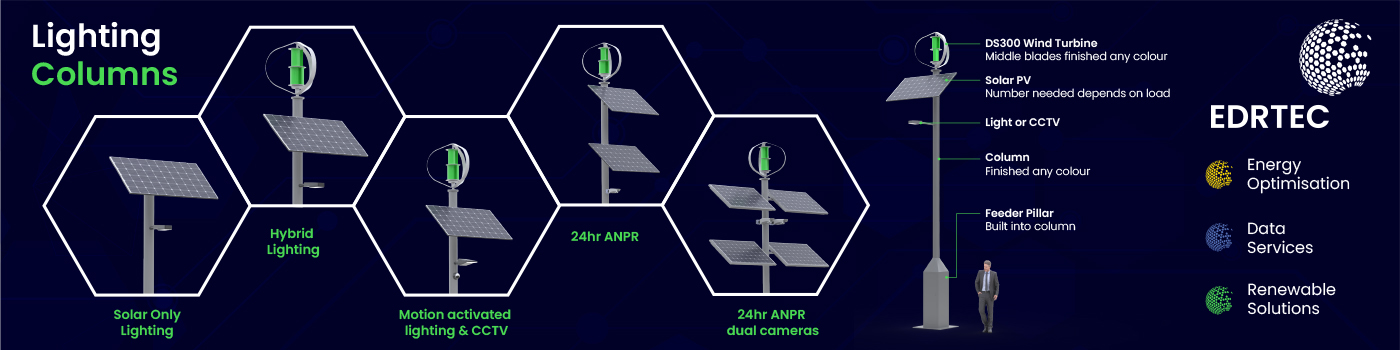
Solar-only lighting was used in areas like car parks and accommodation units. These were set to run at 30% illumination to avoid energy wastage and night-time inconvenience, but incorporated PIR (passive infrared) sensors that would temporarily switch to 100% when triggered by movement.
Larger solar lighting towers were deployed at work areas and Prolectric’s telemetry and software services could determine the optimum illumination level for the prevailing time and season, and set it without a perceptible reduction in lighting but minimising energy use. The correct location and alignment of the solar panels could also be monitored. The company’s ProPower solar hybrid generators were used for site equipment, incorporating a 3kWh solar array, a 35kWh battery and a biofuel-compatible backup generator to provide charge if needed.
Alex said that overall, it was important to calculate as early as possible a project’s exact power requirements, which would enable the most appropriate equipment to be selected in terms of carbon reduction and cost savings.
Hilti’s Thibaud Lefebvre said that implementation of sustainability strategies often broke down through inconsistent implementation and lack of awareness in practice. He suggested five ‘pillars’ that could be borne in mind to help ensure successful take-up, the first being smart management of equipment and assets. Many sites typically had more items than they really needed, with some being duplicated, under-used or even lost, resulting in unnecessary costs and sustainability implications associated with manufacture and embedded carbon.
Hiring equipment rather than outright ownership could reduce these through optimising usage and maximising a product’s usable life. Under its Fleet Management programme, Hilti could service, repair and maintain equipment in peak condition for efficient operation, and its ON!Track asset management system could monitor usage and performance via on-tool electronic tags.
Outlining the other three sustainability pillars, Hilti’s Vijayashree Ballari suggested sites could design out inefficiency before opening by using software to model construction material volumes and product wastage. Adopting modern practices like off-site prefabrication, value engineering and BIM (building information modelling) could achieve savings and reduce embedded carbon.
Pillar four was putting people first in terms of health and safety, adopting measures such as on-tool dust management and low-vibration equipment to protect workers and reduce the likelihood of absenteeism.
Finally, Vijayashree said that clients and contractors were increasingly seeking reliable carbon data at earlier design and procurement stages, such as environmental product data (EPD) information and embedded carbon details. This enabled work teams to compare options on both cost and carbon, not just price.
● Subscribe free to the blog here to make sure you receive my regular news updates for tool hire and plant hire professionals.