
The power of beer
13 August 2025
A novel way of understanding the difference between apparent power and real power when sizing the generators and other equipment needed for a site was given by Prolectric Services in a recent webinar.
Richard Randall, Product Development Manager with the specialist solar and hybrid power and lighting machinery manufacturer, likened the process to looking at a glass of beer, in the presentation entitled Transitioning from Diesel to Renewable Alternatives.
The total contents comprising the liquid and the foam head represented the apparent power which is typically measured in kVA, but the real power was depicted by the beer alone, quoted in kW.
The real power, or the amount of actual work that could be done, was always lower because some energy would be used in a reactive way, such as when motors or transformers start up. This loss was like the foam head: apparent, but not effective in a practical sense.
Richard explained that a convenient way of converting kVA to kW was to multiply by a power factor of typically 0.8; conversely dividing the kW figure by 0.8 would give kVA. Another useful parameter is the kilowatt-hour (kWh) which is the energy delivered by 1kW for one hour, meaning that a 100W light bulb running for ten hours would use 1kWh.
For example, to obtain 24kW of usable power would require a 30kVA generator. However, machines are often over-specified and it can be difficult to estimate what will be needed exactly in practice.
Richard said that some specifiers often took a common approach based on the peak rating amperage of the number of sockets requested. Ten 32A sockets drawing a maximum of 8kW each would require an 80kW supply from a 100kVA generator.
But sites would frequently need considerably less power for basic operations, meaning that the generator was too large for most purposes and costing more just in order to deliver occasional peak needs. Diesel generators also run most efficiently at around 75% loading, so operating at low speeds could lead to excessive fuel consumption and greater servicing requirements.
“Renewable generators such as solar generators are excellent at running lower loads by using power directly from the solar panels and batteries,” said Richard. “The backup diesel generator kicks in for higher loads, if it is required at all. This allows you to much more efficiently size the generator to meet your needs.”
He emphasised the importance of carrying out a site energy assessment listing all the equipment that would be used and totalling the power requirements in kW. There would invariably be a range of items with different energy needs, from power tools and lights to site cabins and welders.
“However, you can also assume that the equipment is not always being run simultaneously or continuously, and the average load might end up at about 50% of the peak load.”
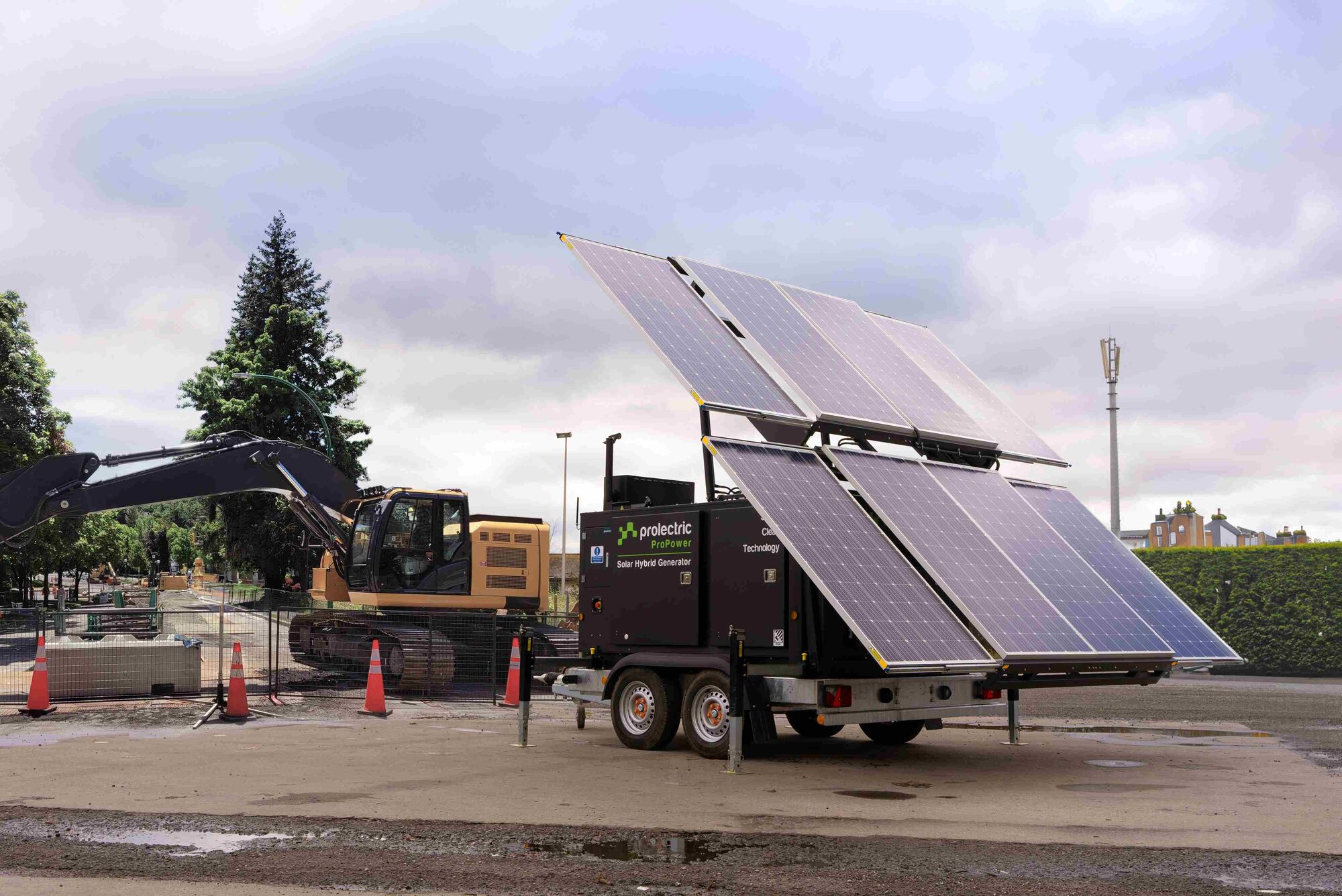
Using a hybrid generator that has an integral battery energy storage system, such as Prolectric’s ProPower unit (pictured), could enable a lower-capacity generator to be selected, with the backup generator available for peak demands.
Richard added that energy monitoring systems could track power usage in real time and optimise power generation accordingly to ensure requirements were met efficiently.
Alex Priddle, Prolectric’s Head of Marketing and Strategic Partnerships, said the company’s telematics data from machines in the field showed that switching from a diesel generator to a ProPower solar hybrid unit would save on average 9,473 litres of fuel annually, with a total operational saving of £18,878 and mitigating 25,388kg of CO2e. This equated to a £95,310 total saving over a seven year depreciation period.
Prolectric will be officially launching its new ProCharge unit at the PlantWorx exhibition on 23 to 25 September at Newark Showground. The machine is a 3-phase solar battery energy storage system that offers an onboard and deployable 5,280W solar panel array, as reported on the blog recently.
● Subscribe to the blog here to ensure you receive regular news updates for tool hire and plant hire professionals, as well as relevant eco-friendly industry developments.