
The journey to sustainability
4 December 2024
Senior Speedy Hire personnel recently gave insights into how the business is embracing sustainability within its organisation, as well as giving advice to customers, suppliers and other stakeholders on their own Net Zero journeys.
During a dozen sessions on topics ranging from product innovation and driving down Scope emissions, to nature positivity and combatting modern slavery, the online Speedy Hire Live – Sustainability Summit on 28 November provided a wealth of knowledge derived from the company’s experiences and practices.
The day-long event was hosted by ex-BBC Blue Peter presenter and Sky Sports anchor Simon Thomas.
Opening the conference Amelia Woodley, Speedy Hire’s ESG Director, said that recent extreme weather events around the globe again highlighted the need to take action to tackle climate change. Furthermore, the construction industry is responsible for some 40% of carbon emissions and embedded carbon.
Under its Decade to Deliver programme, Speedy has committed to achieve net zero carbon emissions by 2040 and. It also plans to be nature positive by 2030 and, amongst its diversity and inclusion aims, to have a 30% female workforce by the same deadline – it’s already at 22%, said Amelia.
The breadth of the event means it’s impossible to cover everything here, but amongst the discussion highlights was one on Speedy’s Journey on Driving Decarbonisation, hosted by Dr James Cadman of the Action Sustainability consultancy, with Speedy’s Head of Net Zero Matthew Pygott; its Property Director Darren Francis; Fleet & Logistics Director Aaron Powell; and Kris Parkes, the hirer’s Training Coordinator.
Matthew Pygott spoke of the comprehensive work Speedy is undertaking to reduce not just its own Scope 1, 2 and 3 emissions, but also in helping customers and those in its supply chain make reductions. He said that positive results would emerge, not least as sites benefited from cleaner, more efficient equipment at premises and on sites.
A particularly interesting challenge was how a company can continue to reduce carbon while its business grows, requiring ongoing action and commitment.
Darren Francis said Speedy was reducing Scope emissions through measures such as procuring electricity from renewable sources and taking actions like installing solar panels on facilities, as well as lowering the company’s energy consumption overall. Where possible, depots and buildings are ‘modularised’ into separate zones with different temperatures: warehouses, say, can be kept cooler than offices and settings can be controlled automatically.
A source of frustration, he said, was that some landlords of leasehold premises were slow to improve buildings to meet mandatory MEE (Minimum Level of Energy Emission) standards, whereby properties must meet specific efficiency levels. Darren said that some property owners were waiting to see what funding assistance might be available and that clarity would hopefully be forthcoming from the new government before too long.
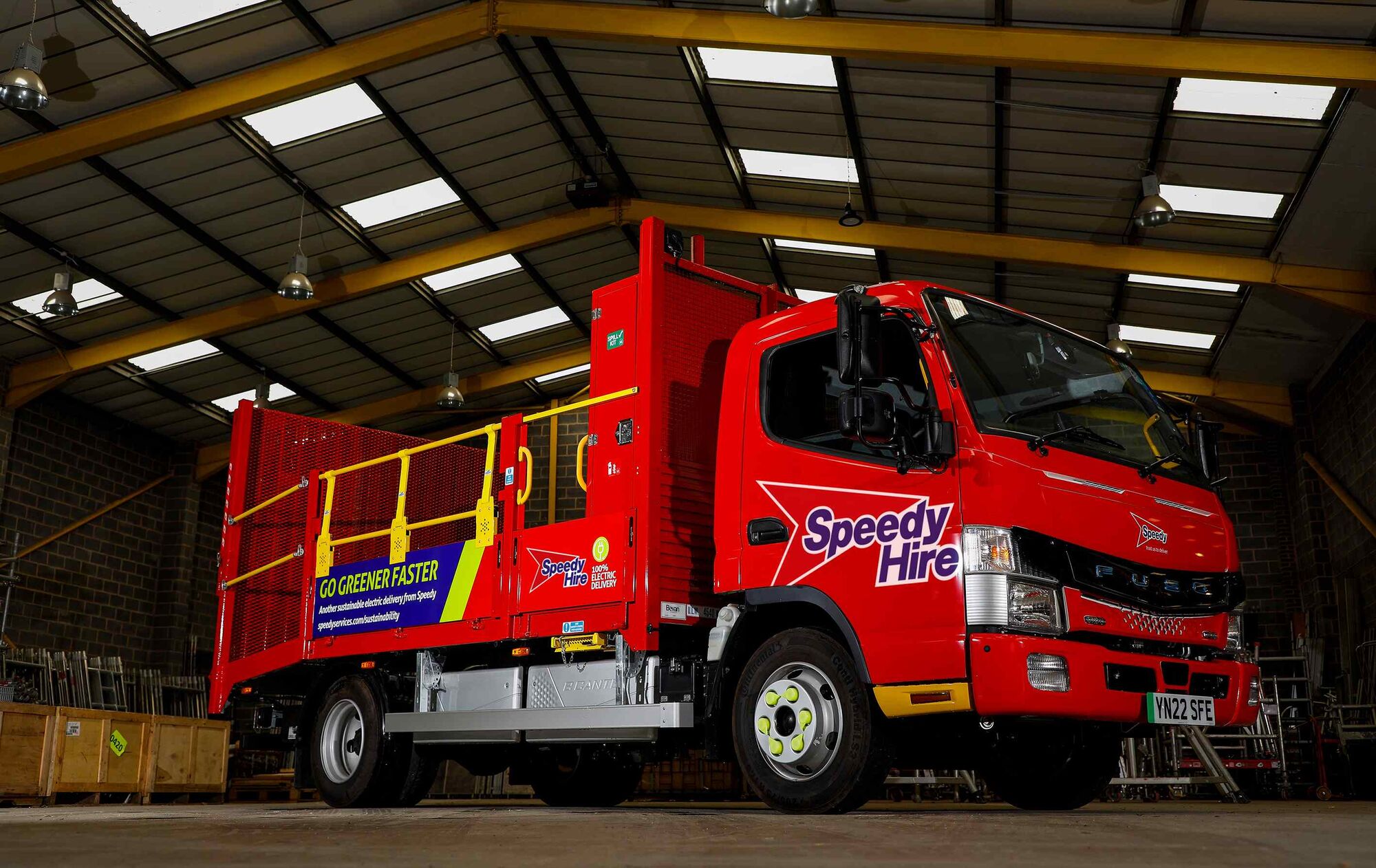
Aaron Powell said that Speedy was steadily adopting more electric vehicles in its fleet, including HGVs weighing 7.5, 18 and 27 tonnes. These were feasible particularly in urban ‘hub’ locations where overall daily distances travelled were relatively smaller and within a shorter radius. As a result, charging concerns were fewer.
A bugbear, however, was that many charging locations are designed to accommodate cars rather than larger vehicles which, as a result, would overhang parking bays. Nevertheless, drivers would typically identify the most convenient charge points quickly and devise appropriate charging routines, which would then become habit.
Kris Parkes agreed that driving EVs required a little forethought. Car charger capacities vary, some being 7.5kW and others 150kW or more for example, so drivers would again need to find the most suitable. But he also pointed out that some drivers might not really need to wait to achieve full charge capacity if, say, 80% would give ample distance to enable topping up at home base. Again, thinking ahead paid dividends.
During the virtual conference, Speedy Hire officially launched its new Diesel-Free Matrix tool designed help customers identify carbon-reducing options to make their work sites more sustainable. This was featured previously on the blog here.
I’ll be reporting on other aspects of the Summit in future blog posts.
● Subscribe to the blog for regular updates here.