Moving from diesel
30 September 2024
Having a full understanding of a work site’s specific power requirements and how to manage eco-friendly equipment in the optimum way would smooth the transition from diesel to renewable alternatives.
That was a key message conveyed in a webinar organised by Prolectric Services, the off-grid renewable power and lighting specialist, presented by its Commercial Director Kathryn Adams and Product Development Manager Richard Randall.
Richard said that reducing or eliminating diesel usage does not just lower emissions, but also gives resistance against global fuel cost fluctuations.
In some situations, solar powered lights like Prolectric’s ProLight and ProRXM mobile lighting towers could run almost autonomously, while for larger sets and bigger machines, using a hybrid solar unit like the company’s ProPower which has a backup diesel generator could reduce fuel usage.
Furthermore, as the generator typically runs only to provide peak loads and to charge the battery, it operates more efficiently, cleanly and will have a longer life. It also means that a smaller generator can often be specified, again giving fuel and cost savings.
On larger sites where multiple batteries power a variety of equipment, consideration had to be given to the recharging infrastructure. More power from the grid is now derived from renewable sources, and other additional energy provision included solar panels, wind turbines and perhaps hydrogen fuel cells, although the last mentioned could be expensive in terms of fuel cost.
Kathryn Adams suggested that a cost benefit analysis could demonstrate the advantages of transitioning from diesel to renewables. Higher initial equipment purchase costs would be outweighed in the long-term by fuel savings, reduced maintenance requirements and more efficient running when using, say, a solar hybrid generator.
She suggested running a pilot project as a trial for obtaining accurate data on costs, carbon savings, fuel reductions and other parameters that could be used to model future requirements at other sites. Data management systems would obviously help with this.
Kathryn cited a case study example of part of a Balfour Beatty highways improvement project on the A63 near Hull involving the careful relocation of an archaeological site. Three electric mini excavators had to be recharged daily, with additional power required for site lighting and a blower keeping a protective tent inflated.
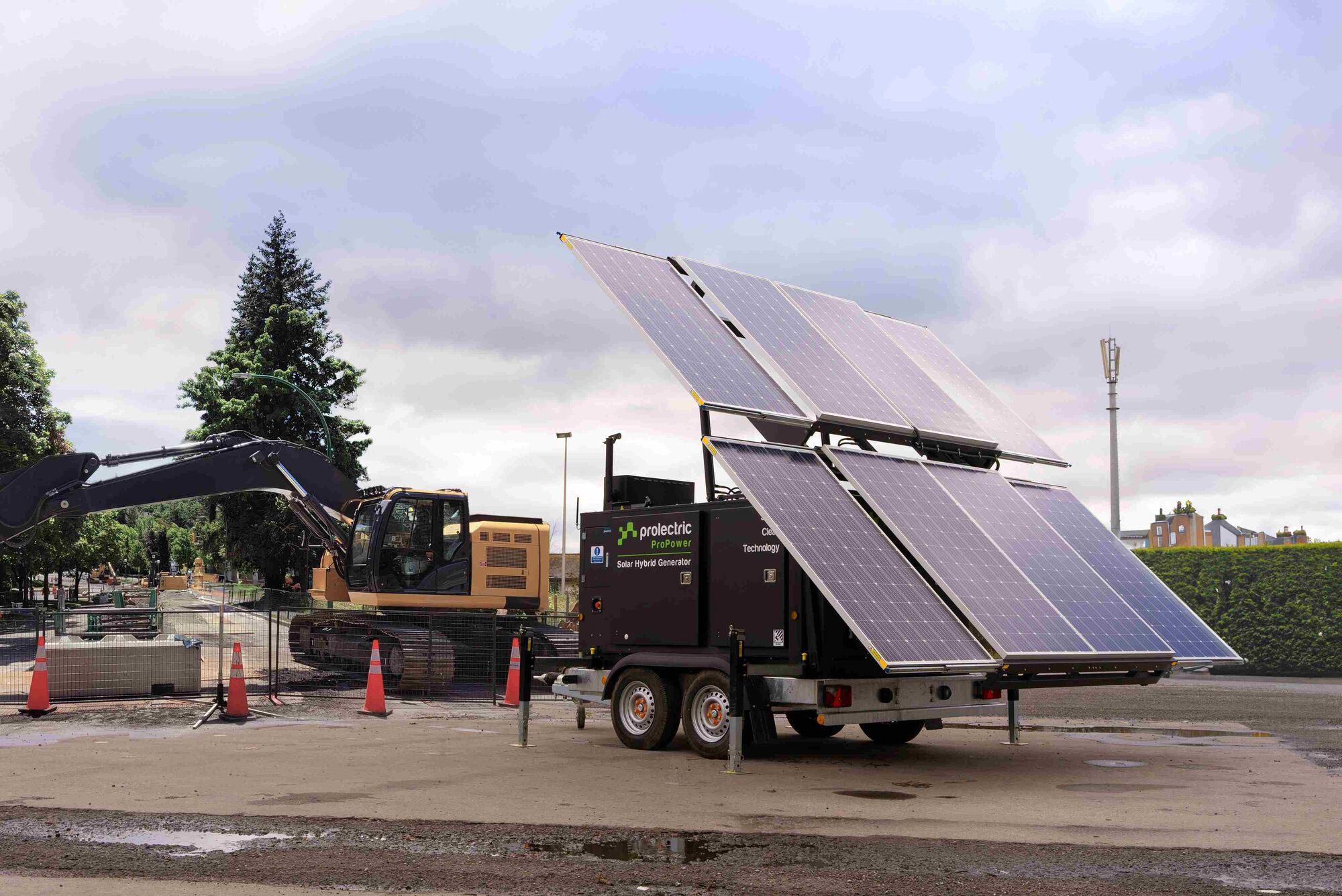
No mains power was available and the enclosed nature of the site meant that diesel fumes had to be avoided. A Prolectric ProPower Solar Hybrid generator (pictured) was used, and an additional benefit was that no trenching or groundworks for cabling were required.
The ProPower ran off its battery alone for 78% of the time, giving a carbon reduction of 7000kg CO2e and fuel savings of 2527 litres, equating to £3,816.