
TCP hits 500
7 August 2024
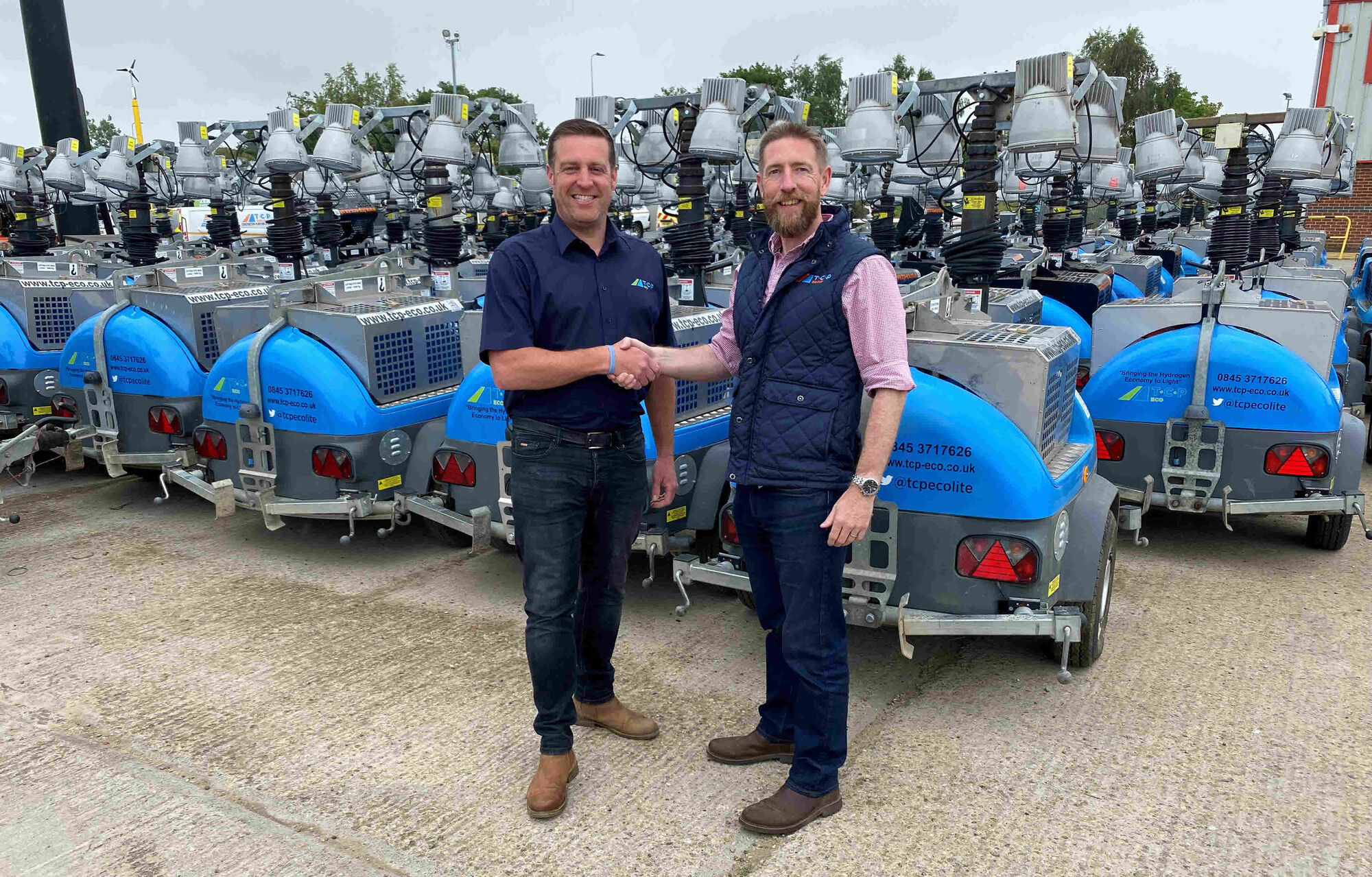
TCP (Taylor Construction Plant) recently reached the milestone of having a fleet of 500 hydrogen fuel-cell mobile lighting towers available to hire, backed by a managed support service.
“The TCP Ecolite TH200 is an increasingly popular choice where temporary lighting is required and as companies look for clean energy solutions to reduce carbon emissions,” said Jim Irvine, the company’s Operations and Development Director.
He added that machines also offer silent running with no risk of fuel spills and zero emissions at the point of use.
TCP’s hydrogen fuel-cell lighting towers have been used on projects such as Cross Rail and at HS2 sites. The company works regularly with the Environment Agency, in partnership with Jackson Civil Engineering, to provide clean energy solutions for works such as canal lock repairs.
Joe Ambor, Sales Director with TCP who is pictured (left) with Jim Irvine, said: “As a company faithful to recycling where possible, we have re-manufactured hundreds of our diesel-powered lighting towers to use hydrogen fuel-cells and gas cylinders.
“Our added-value is to provide a fully managed gas service. Gas usage is monitored remotely and when a hydrogen gas cylinder needs exchanging, the TCP team make arrangements with the customer to replace the empty cylinder with a full one and then take the empty one away.”
TCP formed a partnership with specialist gases supplier BOC in 2010 to replace diesel fuel with hydrogen fuel-cells in its lighting towers to meet growing demands for more environmentally friendly site equipment.
The machines are fitted with Prismalence lenses for controlled light distribution with low glare, good visibility, accurate colour rendering and no flickering for a more comfortable working environment.
● Founded in 1989 by Andrew Barker, who is currently Managing Director, TCP Group began as a plant hire company (in fact, I’m old enough to remember that the business was among the first to introduce lighting towers with metal halide lamps in the early 2000s to replace tungsten halogen models.) It has spent the last decade investing in research and development to expand the ‘eco’ side of its business with hydrogen-powered generators, sentry boxes, CCTV and security monitoring systems.
TCP is to launch a range of training courses for customers to understand how hydrogen-based equipment can help with their own sustainability credentials.