

Merits of modular
23 March 2026
The breadth of topics covered by the presentations at the Modular Building & Portable Building Association’s national conference, held recently at the National Memorial Arboretum in Staffordshire, showed the significance of these structures and related products across a wide range of industries.
Indeed, in her opening remarks, MPBA Chief Executive Jackie Maginnis observed that the Association had certainly broadened significantly since its origins back in 1938, when the first modular building makers were farmers adapting chicken sheds. Today, the industry encompassed mobile towable units, accommodation units, site offices and modular buildings for entire schools, hospitals, courtrooms and similar essential facilities.
The conference’s overall theme was Building the Future: Sustainable, Safe and Ready to Move. Stephen Wightman, UK Modern Methods of Construction [MMC] Lead and Director with the AtkinsRéalis consultancy, gave thought-provoking insights into broadening the take-up of this way of building. He said that traditional construction workers were three times more likely to take their own lives, but this figure might be reduced through adopting off-site construction techniques that enabled people to work regular hours in controlled, factory-like facilities and familiar surroundings, while maintaining close local contact with friends and family.
He also suggested that clients’ decisions were often dictated by initial low price and short-term considerations, rather than taking account of additional factors like sustainability, recycling and repurposing of products, where MMC could have a positive impact. It also encouraged standardisation of products and practices, again reducing costs.
Padmapriya Ramamoorthy from the Elemental Consulting Group outlined work the practice had done in partnership with the MPBA and Swansea University to develop strategies for members to address sustainability in their operations. This includes the Association’s ‘Roadmap to Net Zero’ publication which outlines practical approachers that can be adopted in understanding and reducing carbon footprints in organisations.
She said there were three core ‘pillars’ a business should focus on: understanding whole-life carbon and benchmarking current performance; developing and committing to an appropriate action plan for making reductions; and then engagement through training and implementation so that everyone throughout the organisation acted with common purpose.
Such measures were probably easier for larger companies to adopt with dedicated teams already in place, and this had created the need for the MPBA’s net zero document to share best-practice ideas.
Swansea University’s research had focused on a number of areas, including developing a methodology for measuring while-life carbon in portable building units, and devising various training courses on topics ranging from understanding whole-life carbon and carbon accounting, to full net zero transition plans.
Marcus Gough, former chairman of the Heavy Transport Association, spoke on bureaucratic challenges caused by certain police forces in the UK when moving abnormal loads, such as large machines and modular structures. (This, incidentally, is an issue raised recently by the CPA, which you can read about here). Problems were caused, he said, because different regional forces interpreted regulations differently, creating inconsistencies and confusion.
Some forces charge very highly for supervising the movement and escorting of vehicles, while others charged considerably less. They also had different advance notification requirements. Marcus Gough said that in extreme cases – most notably within the West Midlands Police region – hauliers could try to avoid the area completely and use a different route, which would be impossible when delivering to sites in that region, such as some HS2 locations. This would waste time, fuel and increase carbon emissions.
He said that the HTA and other industry bodies were engaging with the Department for Transport to seek greater clarity and consistency.
In another conference session, James Haslam, Kirsty Woods and Ross Ward from the CITB National Construction College gave details of a new apprenticeship for trainees in the modular building industry, developed in association with the MPBA. This Level 2 apprenticeship option for Construction, Assembly and Installation Operators for relocatable and modular buildings is expected to take its first cohort of entrants in September.
The programme will combine residential courses, most lasting two weeks each at the NCC Bircham Newton campus in Norfolk, with on-the job employer workplace training. The content will be roughly 80% practical in nature and 20% theory-based, and will typically span 18 months.
The training can be tailored to individual requirements, covering essential skills and requirements such as manufacturing, installing, finishing and moving modular components and structures. It will also include areas such as connecting connected services, preparing for transportation and Health & Safety considerations in construction, and should give industry entrants a solid foothold in this growing industry.
Other speakers focused on how new technology can enable operators of modular buildings to reduce energy costs and lower their carbon foot print. More about that in a future blog post.
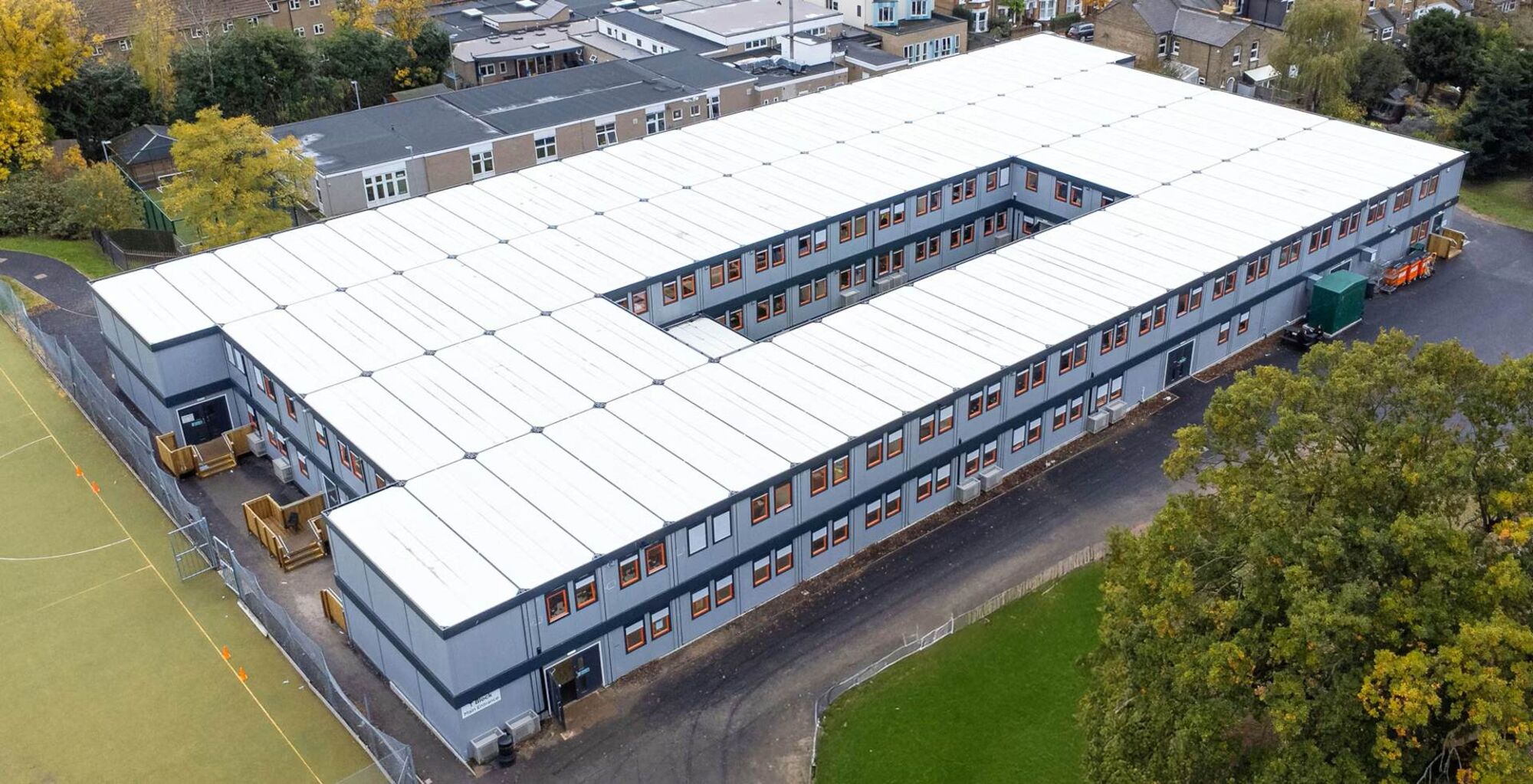
Photo shows the Highams Park School project near Woodford in London undertaken by Pickerings Hire, comprising some 164 modular bays.
● Subscribe free to the blog here to make sure you receive my regular news updates for tool hire and plant hire professionals.