

CPA urges Government action
12 November 2025
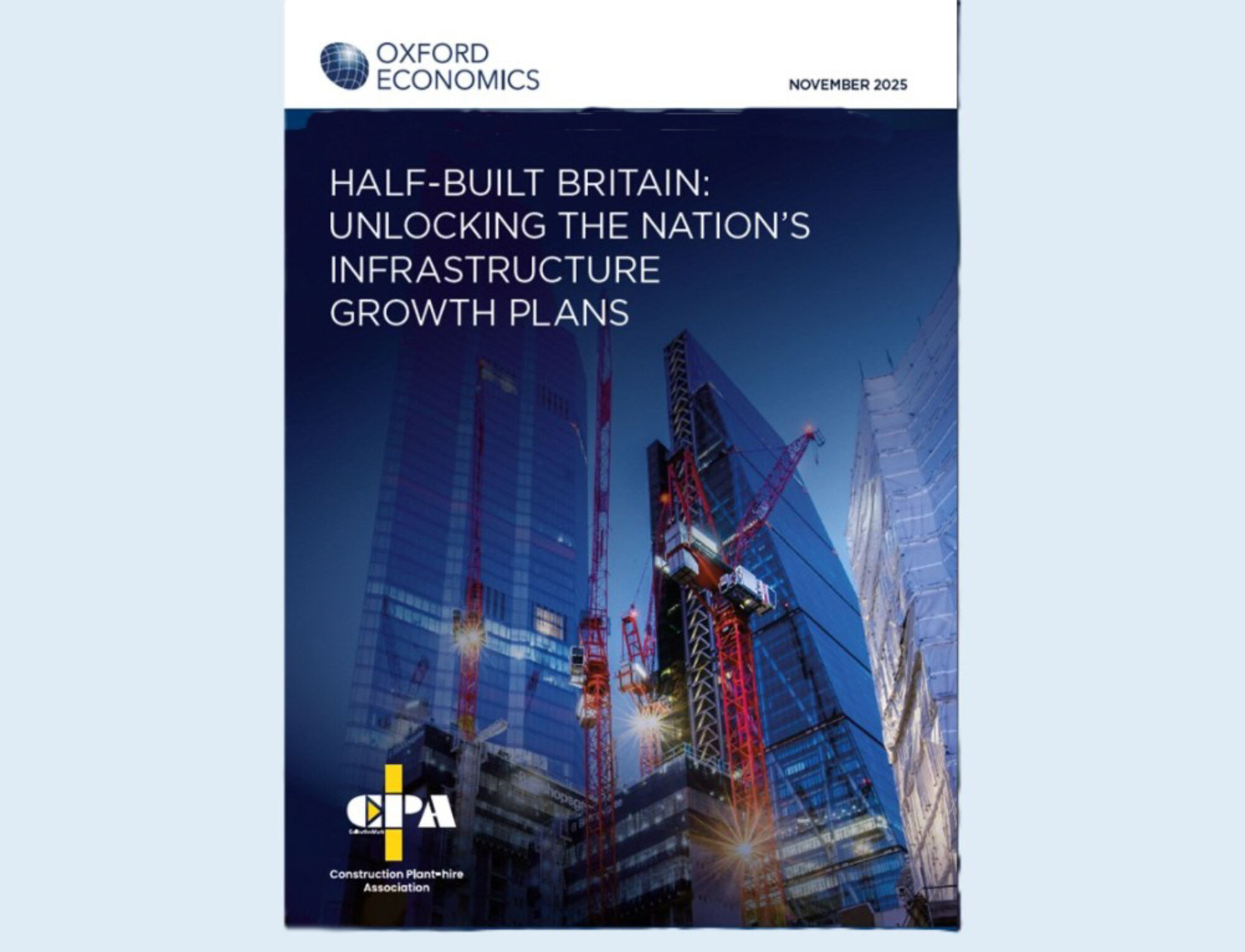
With little more than a fortnight before the chancellor’s Autumn Budget statement on 26 November, a major new report by the respected Oxford Economics consultancy for the CPA warns that Britain’s £530 billion construction and infrastructure pipeline is “starting to crack”, with skills shortages, falling investment and delivery delays threatening to derail government growth plans.
The report, entitled ‘Half-built Britain: Unlocking the Nation’s Infrastructure Growth Plans’, warns that Britain’s construction engine is stalling under the combined strain of skills shortages, weak investment and chronic delivery delays. This is leaving flagship projects, from new hospitals and homes to airport expansions, at risk of grinding to a halt.
However, the document also highlights the opportunity for government and industry to work together to unlock investment and close the productivity gap, a step that could generate up to £315 billion in long-term economic growth, helping fund national priorities without adding to public debt.
The analysis warns that while ministers talk of “getting Britain building”, much of the pipeline “lacks the workforce, certainty or funding to move beyond announcements.” Businesses that provide the machinery and skilled operators underpinning construction say they cannot plan or invest without predictable workloads, leaving delivery capacity “dangerously thin”.
The report says the UK needs 250,000 additional construction workers to deliver planned projects, yet nearly half a million employees are due to retire in the next 15 years. It says that 44% of firms report labour shortages restricting activity, described as the worst figure of any major UK sector.
Additionally, apprenticeship completion has slumped to 53%, while pay for young workers in construction has fallen below wage rates in the retail sector, says the report.
Other findings are that construction productivity has declined 0.1% a year since 1997, leaving output per worker below 1990s levels, and only 14% of major government projects are rated on track.
Furthermore, funding certainty plunges from 68% this year to just 33% by 2030, creating what Oxford Economics calls “a crisis of confidence” for investors and contractors.
The report identifies Britain’s productivity difficulty as primarily a capital problem. Decades of under-investment in machinery, technology and infrastructure have left the UK falling behind its competitors. Whereas manufacturing productivity has risen by 3.5% a year since the late 1990s, construction has gone backwards.
Steven Mulholland, CEO of the CPA, said: “This report is a call to action for ministers. Britain’s construction pipeline is cracking under the strain of unrealistic targets, uncertain funding and a shrinking workforce.
“Unless the Government restores confidence and fixes the fundamentals, the next decade will be defined by half-built promises and rising costs. The plant-hire sector is one of the most capital-intensive in the economy, with our members shouldering much of the investment risk needed to keep Britain building. With stable policy and predictable pipelines, we can channel private capital into public infrastructure without adding to national debt.
“If ministers match our willingness to invest with clarity and confidence, we can turn ambition into action and build the growth, jobs and prosperity Britain needs.”
The report warns that “announcements are outpacing delivery capacity”, with too few projects fully costed or ‘shovel-ready’. It highlights that construction productivity has fallen consistently because investment in capital equipment and infrastructure has lagged behind peer economies. In contrast, countries such as Germany and France, which have maintained stable capital pipelines, have seen sustained productivity growth despite similar demographic pressures.
Oxford Economics notes that while government capital spending is set to rise by 3.6% annually to 2029-30, much of this increase is already absorbed by energy transition costs and existing liabilities, leaving transport, housing and local infrastructure underfunded.
To break that cycle, the CPA has submitted a package of policy proposals to the Treasury ahead of the Autumn Budget to stabilise delivery and restore business confidence across the construction supply chain.
The CPA plan includes the suggestion that the government should publish a fully costed update of the National Infrastructure Pipeline with secured funding beyond 2028. It should also reverse the rise in employer National Insurance, easing labour-cost pressures across construction supply chains.
The association also advocates extending full expensing to leased assets, allowing hire companies to reinvest £1.3 billion a year in new capital equipment, as well as maintaining the current Fuel Duty rate, protecting SMEs hit by the loss of red diesel relief.
Other CPA recommendations include retaining Business Property Relief, preventing succession-related closures of family-run firms, and reform the Growth and Skills Levy to give employers full flexibility and fund all SME apprenticeships
The CPA argues that the Government can still harness the strength of the construction sector to deliver its growth ambitions, with every £1 spent generating £3 in wider economic value.
Let’s see what the chancellor delivers on 26 November…
● Subscribe free to the blog here to make sure you receive my regular news updates for tool hire and plant hire professionals.